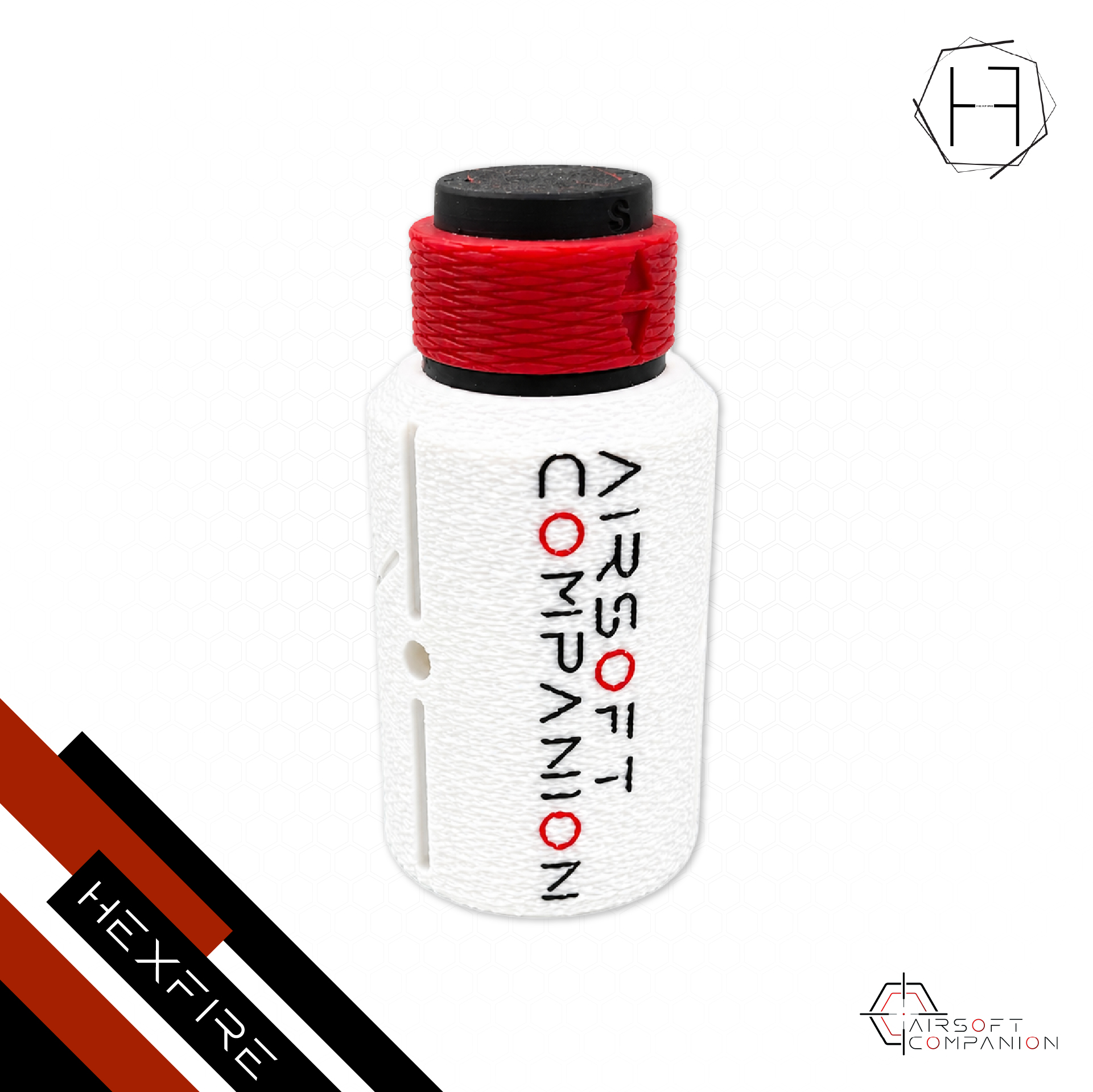
How Airsoft Grenades Work
Gas, impact, spring: airsoft grenades all do the same job, which is putting BBs in a space you cannot shoot into. They simply get there in very different ways. Here is what actually happens when you pull the pin.
What an airsoft grenade actually does
An airsoft grenade is a reusable BB dispenser with a trigger delay. Instead of an explosive charge, it stores energy (compressed green gas, CO2, or a spring) and releases it in one burst, throwing plastic BBs in every direction from where it lands. There is no fragmentation and no fire; the only projectile is the same 6 mm BB your rifle fires, usually at low energy over a short radius.
Because the effect is a short range spray rather than a blast, grenades are a room clearing and position breaking tool. They matter most in CQB, in trench and building objectives, and any time a defender sits behind cover that a rifle line simply cannot reach.
Gas grenades
Gas grenades are the most common reusable type in Europe. You fill the body with green gas (or CO2 on some models), load BBs into the shell, and arm a valve held shut by a pin or lever. When the trigger releases, the gas escapes through the BB channels and pushes the payload out. Capacity depends on the model, but roughly 100 to 200 BBs spread across a few metres is typical.
- Delay: most designs fire on release of the pin after a fixed fuse of a few seconds, so the throw has to be timed.
- Reuse: unscrew, refill gas, reload BBs, arm it again. A single grenade lasts seasons if the seals are looked after.
- Cold weather: green gas loses pressure below roughly 10 °C, which shortens the spread. CO2 models are less affected.
Impact grenades
Impact grenades skip the timer: the valve opens when the body strikes a surface hard enough. That makes them predictable indoors, because the BBs leave the shell exactly where the grenade lands, not two seconds later while it is still rolling.
The compromise is that a soft landing (mud, grass, a mattress) can fail to trigger them, and a mistimed drop can set one off at your own feet. Most fields treat impact models as CQB equipment and ask that they are thrown, never rolled.
Spring and pyrotechnic alternatives
Spring powered grenades trade range for simplicity: no gas to refill, but a weaker spread. Pyrotechnic devices (blank firing, thunder B style, or friction fused) produce a bang rather than BBs, and they are regulated far more strictly. Many European fields, and most couriers, do not accept them at all. If you play internationally, gas and impact models are the two types you can realistically travel and order with.
Field rules to check before you buy
Grenade policy is set field by field, not by the manufacturer. Before buying, check three things with your site:
- Are grenades allowed indoors? Some CQB sites permit impact models only.
- What counts as a kill? Radius rules differ: some fields kill everyone in a room, others only players actually struck by a BB.
- Minimum engagement distance: a grenade throw is usually exempt from the MED that applies to rifle fire, but the rule needs to be confirmed rather than assumed.
Shipping is the other constraint: several European countries restrict gas filled or pressurised devices by post. On our product pages, the destinations we cannot deliver a given item to are listed before checkout, so an order never fails silently.
Maintenance that keeps a grenade working
Almost every dead grenade is a dead seal. After a game day, empty any remaining BBs, release residual gas, wipe the shell, and put a drop of silicone oil on the fill valve every few refills. Store it depressurised: a grenade left charged all winter is the one that leaks in spring.